
Blog
Grenades fraîches ou surgelées : différences, utilisations et guide d'exportation

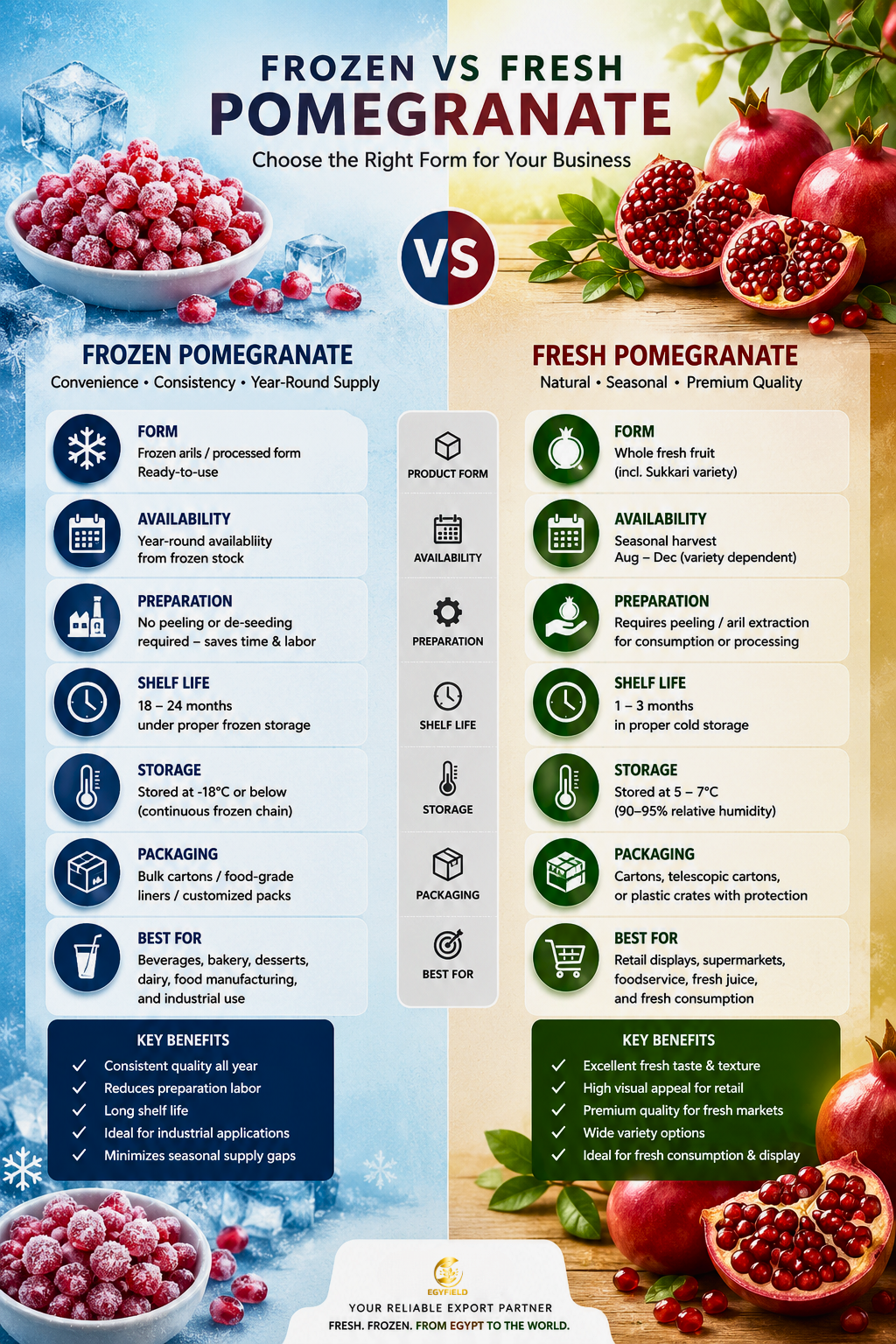
Grenades fraîches ou surgelées : différences, utilisations et guide d'exportation
Fil d'Ariane : Accueil > Centre de connaissances > Produits frais > Grenade > Grenade fraîche ou surgelée ?
Écrit par : Équipe de contenu d'EgyField
Révisé par : Équipe Produits et Export d'EgyField
Dernière mise à jour : août 2026
Réponse rapide
Grenade fraîche Il est commercialisé sous forme de fruits entiers et convient principalement à la vente au détail de produits frais, à la restauration et aux marchés où l'aspect, la fermeté et la fraîcheur de saison sont des critères importants. Grenade congelée, en particulier les arilles surgelés, sont transformés et surgelés afin d'offrir une solution pratique aux fabricants de produits alimentaires, aux producteurs de boissons, aux boulangeries et à d'autres secteurs nécessitant une disponibilité tout au long de l'année.
Le choix approprié dépend de l'utilisation prévue par l'acheteur, de la durée de conservation requise, des besoins en matière de transformation, du conditionnement, des installations de stockage et des exigences du marché de destination.
[Demander un devis B2B]
En bref
| Article | Grenade fraîche | Grenade congelée |
|---|---|---|
| Formulaire principal | Fruit entier | Arilles surgelées / sous forme transformée |
| Principales utilisations | Commerce de détail, restauration, consommation de produits frais | Boissons, boulangerie, agroalimentaire |
| Disponibilité | Saisonnier | Toute l'année, à partir de produits surgelés |
| Traitement | Nécessite un épluchage et une extraction de l'arille | Exigences de préparation réduites |
| Stockage | Entrepôt frigorifique | Stockage en congélateur |
| Principaux centres d'intérêt des acheteurs | Aspect, taille, fermeté, fraîcheur | Constance de la qualité, facilité d'utilisation, continuité de l'approvisionnement |
| Type d'approvisionnement | Exportation B2B | Exportation B2B |
Introduction
Les grenades égyptiennes sont commercialisées sur les marchés internationaux sous différentes formes, notamment grenades entières fraîches et produits à base de grenade surgelés à des fins commerciales diverses.
Pour les importateurs et les entreprises du secteur agroalimentaire, le choix entre les produits frais et les produits surgelés ne relève pas simplement d'une question de préférence. Cette décision dépend de l'utilisation prévue, de la saisonnalité, de la durée de stockage requise, des exigences en matière de transformation, du conditionnement et des capacités de la chaîne du froid.
Comprendre ces différences aide les acheteurs à choisir le produit adapté à leurs besoins dans les secteurs de la grande distribution, de la restauration, de la production de jus, de la boulangerie et de l'industrie agroalimentaire.
Grenade fraîche
Les grenades fraîches sont exportées sous forme de fruits entiers et sont principalement destinées aux marchés où le produit est vendu ou transformé à l'état frais.
En ce qui concerne les exportations de produits frais, les acheteurs accordent généralement une grande attention à aspect du fruit, taille, fermeté, état de la peau, état de la couronne, qualité interne et maturité globale.
Variétés de grenades fraîches
L'Égypte produit plusieurs variétés de grenades. Grenade Sukkari C'est un exemple de variété fraîche, réputée pour son goût plus sucré et son acidité moindre par rapport aux variétés plus acidulées.
Les différentes variétés commercialisées peuvent présenter des différences au niveau :
- Taille des fruits
- Couleur de peau
- Couleur de l'arille
- Douceur et acidité
- Caractéristiques des graines
- Période de récolte
- Marché cible
Le choix final des variétés doit être fonction du marché de l'acheteur et des spécifications du produit.
Grenade congelée
La grenade surgelée est généralement commercialisée sous des formes telles que graines congelées, ce qui permet aux entreprises du secteur alimentaire d'utiliser ce fruit sans devoir procéder à un épluchage et à une extraction aussi poussés que ceux requis pour les fruits frais entiers.
La grenade surgelée peut s'avérer particulièrement utile pour les entreprises qui ont besoin :
- Disponibilité prolongée au-delà de la saison de récolte des produits frais
- Traitement pratique
- Un approvisionnement régulier pour la production
- Réduction du temps consacré à la préparation
- Utilisation dans les boissons et les aliments transformés
Pour les acheteurs industriels, les arilles surgelés peuvent constituer une solution pratique lorsque les fruits frais ne sont pas disponibles ou lorsque le processus de production nécessite un ingrédient à base de fruits prêt à l'emploi.
Grenade fraîche ou surgelée : les principales différences
| Fonctionnalité | Grenade fraîche | Grenade congelée |
|---|---|---|
| Forme du produit | Fruit entier | Principalement sous forme d'arilles congelées ou transformées |
| Disponibilité | Principalement saisonnier | Peut être disponible toute l'année |
| Préparation | Nécessite un épluchage et une extraction | Préparation allégée |
| Stockage | Réfrigéré | La Reine des neiges |
| Présence en magasin | Très important | Moins pertinent que dans le secteur de la vente au détail de produits frais |
| Traitement | Plus exigeant en main-d'œuvre | Idéal pour un usage industriel |
| Idéal pour | Commerce de détail, restauration, consommation de produits frais | Jus, produits de boulangerie, boissons, industrie agroalimentaire |
| Planification des approvisionnements | Planification saisonnière requise | Convient à la planification de la production à long terme |
Saison de la récolte des grenades fraîches
La saison des grenades égyptiennes varie en fonction de variété, conditions de culture et région de production.
La mise sur le marché des produits frais commence généralement par les variétés précoces et se poursuit tout au long de la principale période de récolte commerciale.
La grenade Sukkari est une variété précoce, tandis que d'autres variétés commerciales peuvent être récoltées plus tard dans la saison.
Dans le cadre de la planification des exportations, les acheteurs doivent vérifier auprès du fournisseur la période exacte de disponibilité de la variété choisie, car les dates de récolte peuvent varier d'une saison à l'autre.
Pourquoi la saison est-elle importante pour les exportations de produits frais ?
Les nouveaux acheteurs doivent tenir compte des éléments suivants :
- Période de récolte
- Disponibilité des variétés
- Demande du marché
- Calendrier d'expédition requis
- Réglementations des marchés de destination
- Durée de conservation prévue
- Exigences relatives à la chaîne du froid
Les produits surgelés, quant à eux, peuvent permettre aux acheteurs de maintenir leur approvisionnement au-delà de la saison de récolte des produits frais, à condition de disposer de stocks surgelés adaptés.
Comment choisir des grenades destinées à l'exportation en frais
Le choix des fruits au bon stade de maturité est un élément essentiel pour garantir la qualité des produits frais destinés à l'exportation.
1. Aspect extérieur
Les fruits doivent présenter un aspect soigné et conforme aux normes commerciales, adapté à la variété choisie et au marché de destination.
Les acheteurs recherchent généralement :
- Teinte de peau appropriée
- Aspect uniforme
- Bon état de la couronne
- Défauts de surface minimes
2. Fermeté
Les grenades fraîches doivent être fermes et bien charnues par rapport à leur taille.
Des fruits trop mous peuvent être le signe d'une altération ou d'une mauvaise manipulation.
3. État de la peau
Les fruits destinés à l'exportation ne doivent présenter aucune des anomalies suivantes :
- Réductions
- Fissures profondes
- Contusions
- Dégâts causés par les champignons
- Dégâts causés par les ravageurs
- Coup de soleil grave
4. Qualité interne
L'apparence extérieure ne suffit pas à elle seule à garantir la qualité intrinsèque.
En fonction des spécifications de l'acheteur, l'évaluation de la qualité peut inclure :
- Couleur de l'arille
- Goût
- Caractéristiques du jus
- Caractéristiques des graines
- Matières solides solubles
- Acidité
- Défauts internes
5. Maturité
Le stade de maturité à la récolte doit être adapté à la variété et au marché visé.
Les fruits doivent avoir développé les caractéristiques attendues de la variété sélectionnée, tout en conservant une fermeté suffisante pour la manutention et le transport.
Emballage de grenades fraîches
Les grenades fraîches peuvent être conditionnées en fonction du marché de destination, des exigences des acheteurs, de la taille des fruits et des conditions de transport.
Les emballages d'exportation courants peuvent inclure :
- Cartons
- Cartons télescopiques
- Caisses en plastique
- Plateaux de protection ou séparateurs
- Emballages de vente au détail personnalisés
L'emballage doit offrir une protection suffisante contre :
- Dommages mécaniques
- Pression
- Mouvements excessifs
- Problèmes liés à l'humidité
- Manutention pendant le transport
Le format d'emballage définitif doit être convenu avec l'acheteur avant l'expédition.
Conservation et transport des grenades fraîches
Les grenades fraîches nécessitent un traitement adapté gestion de la température et de l'humidité afin de préserver la qualité pendant le stockage et le transport.
Une chaîne du froid contrôlée permet de réduire :
- Perte d'humidité
- Perte de poids
- Dégradation de la qualité
- Adoucissement excessif
Les conditions de stockage doivent être choisies en fonction de la variété, du degré de maturité, du traitement post-récolte, du mode de conditionnement et des exigences de la destination.
Pour les expéditions internationales, il est essentiel de garantir des conditions adéquates tout au long de la chaîne logistique, depuis l'emballage jusqu'au transport et à la livraison.
Conditionnement et conservation des grenades surgelées
Les produits à base de grenade surgelés nécessitent une chaîne du froid ininterrompue.
Les arilles surgelés peuvent être fournis sous les formes suivantes :
- Cartons en vrac
- Doublures intérieures de qualité alimentaire
- Emballages industriels
- Emballages de vente au détail personnalisés
La taille d'emballage appropriée dépend de l'utilisation prévue par l'acheteur et de ses besoins de production.
Les produits surgelés doivent être conservés dans les conditions de stockage convenues pendant toute la durée du transport et du stockage.
Il est essentiel d'éviter les variations de température ainsi que les cycles répétés de décongélation et de recongélation pour préserver la qualité du produit.
Applications : quelle formule convient le mieux à votre entreprise ?
Grenade fraîche
Commerce de détail
Les supermarchés et les magasins spécialisés dans les fruits et légumes frais peuvent proposer des grenades entières en fonction de leur taille, de leur aspect et de leur variété.
Restauration
Les hôtels, restaurants, cafés et entreprises de restauration peuvent utiliser des grenades fraîches pour préparer des jus frais, des salades, des garnitures, des desserts et d'autres préparations.
Jus frais
Les fruits frais peuvent être transformés en jus lorsque la transformation à partir de fruits frais fait partie des activités de l'acheteur.
Grenade congelée
Production de boissons
Les grenades surgelées peuvent être utilisées dans les jus, les smoothies, les mélanges de boissons et d'autres boissons à base de fruits.
Pâtisserie et desserts
Les arilles surgelés peuvent être utilisés dans la confection de gâteaux, de pâtisseries, de desserts, de garnitures, de fourrages et dans d'autres préparations.
Industrie agroalimentaire
Les arilles surgelés peuvent être incorporés dans des produits alimentaires transformés pour lesquels il est important de disposer de cet ingrédient tout au long de l'année.
Restauration
Les produits surgelés peuvent permettre de se procurer facilement des grenades en dehors de la période de récolte, selon l'utilisation prévue.
Frais ou surgelés : que choisir ?
Le choix le plus judicieux dépend du modèle économique de l'acheteur.
Quand choisir une grenade fraîche :
- Vous vendez des fruits frais entiers.
- L'aspect est un facteur déterminant dans la décision d'achat.
- Vous approvisionnez les marchés de détail de produits frais.
- Votre entreprise est en mesure de gérer le stockage réfrigéré.
- Vous avez besoin de fruits frais destinés à la restauration ou à la transformation.
Optez pour la grenade surgelée dans les cas suivants :
- Il vous faut un ingrédient à base de fruits prêt à l'emploi.
- Votre production fonctionne toute l'année.
- Vous souhaitez réduire le temps consacré à l'épluchage et à la préparation.
- Vous fabriquez des boissons, des produits de boulangerie, des desserts ou des produits alimentaires transformés.
- Votre entreprise dispose d'installations de stockage frigorifique adaptées.
Qualité des exportations et documentation
Les expéditions internationales de grenades doivent répondre à la fois aux exigences de l'acheteur et à celles du marché de destination.
Selon le produit et la destination, les formalités d'exportation peuvent inclure :
- Caractéristiques techniques du produit
- Exigences en matière de qualité et de classement
- Spécifications d'emballage
- Exigences en matière d'étiquetage
- Exigences en matière de sécurité alimentaire
- Documents phytosanitaires relatifs aux produits frais concernés
- Certificats et documents exigés par le pays de destination
- Limites maximales de résidus (LMR)
- Exigences en matière de température et de chaîne du froid
Des certifications telles que GlobalG.A.P., HACCP ou ISO 22000 Cela peut s'avérer pertinent en fonction de l'exploitation agricole, du site de transformation, du produit et des exigences de l'acheteur. Il convient de toujours vérifier la disponibilité des certifications spécifiques pour chaque expédition.
Que doivent vérifier les acheteurs B2B avant de passer commande ?
Avant de passer commande, les importateurs et les fabricants de produits alimentaires doivent s'assurer que :
- Variété de grenade
- Sous forme fraîche ou surgelée
- Taille des fruits ou caractéristiques du produit
- Format de conditionnement
- Poids net par emballage
- Durée de conservation requise
- Température de stockage
- Quantité minimale de commande
- Certifications requises
- Documentation relative au marché de destination
- Conditions d'expédition
- Calendrier de livraison
- Incoterms
- Exigences en matière d'étiquetage
Les spécifications peuvent varier en fonction du marché de destination et des exigences de l'acheteur ; il convient donc de confirmer les détails commerciaux et techniques définitifs avant l'expédition.
Foire aux questions
Quelle est la principale différence entre les grenades fraîches et les grenades surgelées ?
Les grenades fraîches sont principalement exportées sous forme de fruits entiers et conviennent à la vente au détail, à la restauration et à la transformation en produits frais. Les grenades surgelées, en particulier les arilles surgelés, offrent un format plus pratique pour l'industrie agroalimentaire, les boissons, la boulangerie-pâtisserie et d'autres applications nécessitant une disponibilité à plus long terme.
Peut-on trouver des grenades surgelées en dehors de la saison des fruits frais ?
La grenade surgelée peut être disponible toute l'année à condition qu'un stock suffisant ait été préparé et conservé dans de bonnes conditions.
Qu'est-ce que la grenade Sukkari ?
La « Sukkari » est une variété de grenade réputée pour son goût plus sucré et son acidité plus faible que celle des variétés plus acidulées. Ses caractéristiques peuvent varier en fonction des conditions de culture et de son stade de maturité.
Qu'est-ce qui est préférable pour la fabrication de jus : des grenades fraîches ou surgelées ?
Les deux peuvent être utilisés pour la production de jus. Le choix le plus judicieux dépend du modèle de production, de la saisonnalité, des exigences de transformation, de la disponibilité de la main-d'œuvre et de la continuité d'approvisionnement souhaitée.
Quel type d'emballage utilise-t-on pour les grenades fraîches ?
Les grenades fraîches peuvent être conditionnées dans des cartons, des cartons télescopiques, des caisses en plastique et des systèmes d'emballage de protection, en fonction de la taille des fruits, de leur destination et des exigences des acheteurs.
Comment conserver les grenades surgelées ?
Les grenades congelées doivent être conservées dans les conditions de stockage à froid convenues, en respectant une chaîne du froid ininterrompue. Il convient d'éviter les variations de température ainsi que les cycles répétés de décongélation et de recongélation.
Que doivent vérifier les importateurs avant d'acheter des grenades égyptiennes ?
Les importateurs doivent vérifier la variété, la forme du produit, les caractéristiques techniques, le conditionnement, la durée de conservation, les certifications, la documentation, les conditions de stockage, les conditions d'expédition et les exigences du marché de destination avant de passer commande.
À propos de ces informations
Ce guide est publié par EgyField dans le cadre de ses ressources documentaires consacrées aux produits agricoles et aux exportations.
Les caractéristiques techniques des produits, leur disponibilité, leur conditionnement, leur durée de conservation, leurs certifications et les exigences en matière d'exportation peuvent varier en fonction de variété, saison, marché de destination, spécifications de l'acheteur et réglementations applicables.
Les spécifications finales du produit et les conditions commerciales doivent être confirmées auprès d'EgyField avant de passer commande.
Achetez des grenades égyptiennes avec EgyField
Que vous recherchiez grenades égyptiennes fraîches destinées à la vente au détail et à la restauration ou produits à base de grenade surgelés destinés à l'industrie agroalimentaire et à une utilisation tout au long de l'année, EgyField peut vous aider à déterminer la forme de produit la plus adaptée et les exigences en matière d'exportation pour votre marché.
Découvrez notre gamme de produits à la grenade
Demander un devis B2B
Contactez l'équipe Export d'EgyField